Neuro Recall Benefits: What Its Ingredients Support
Quick answerNeuro Recall pairs vitamin B12 and folate with ten herbs and nutrients studied for attention, blood sugar or eye health.
Vitamin B12 and folate matter most if your levels are low. Daily habits also play a big part, so the supplement works best alongside them.
See every ingredient and its amount.
- Refund terms shown at checkout
- Shipping cost shown before you pay
What does “benefit” mean for a memory supplement?
For a supplement, a benefit is only real if a fair study shows it. That means a trial that compares the product with a dummy pill. For Neuro Recall, nobody has published one.
So this page does something narrower. It looks at what each ingredient on the label has been studied for, and what those studies found. “Studied for” is not the same as “works for.” Many studies found small effects or none at all.
Two rules shape what any brand can say. Supplements reach shelves without any FDA approval step (FDA, Q&A on Dietary Supplements). The FTC says health claims in ads need solid scientific support (FTC, Health Products Compliance Guidance). Keep both in mind when you read any memory product page, including this one.
What the brand graphics say, and what the label says
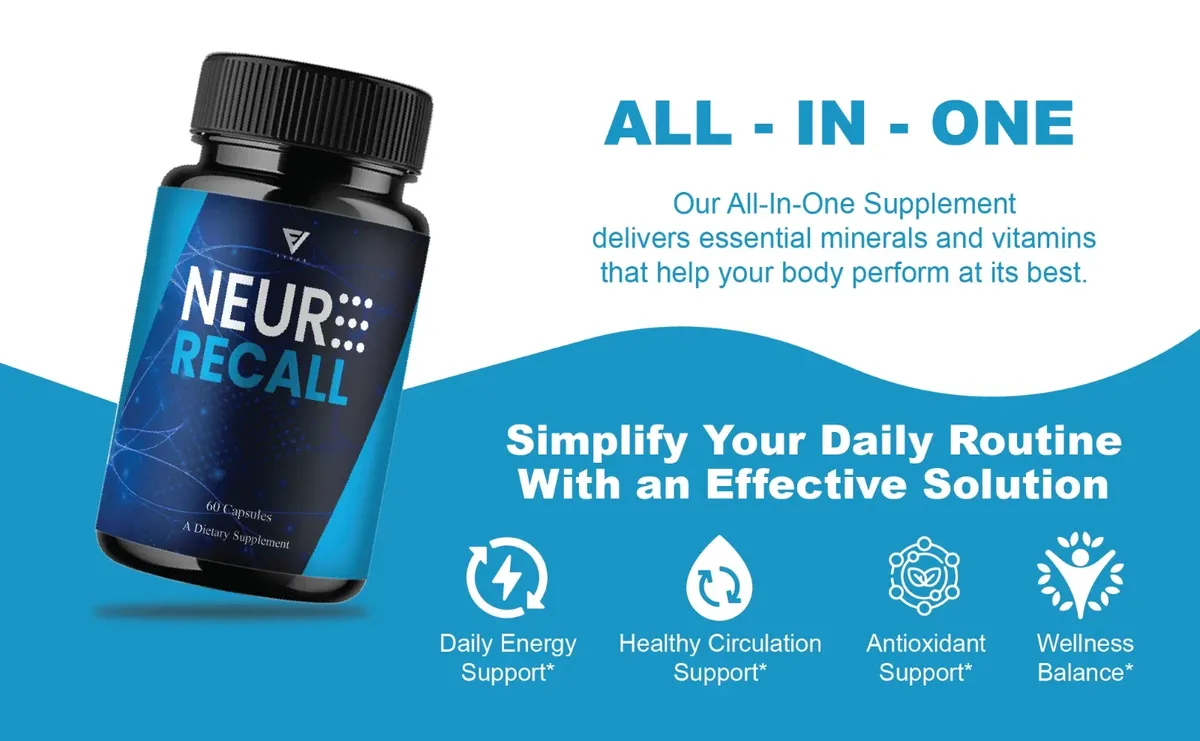
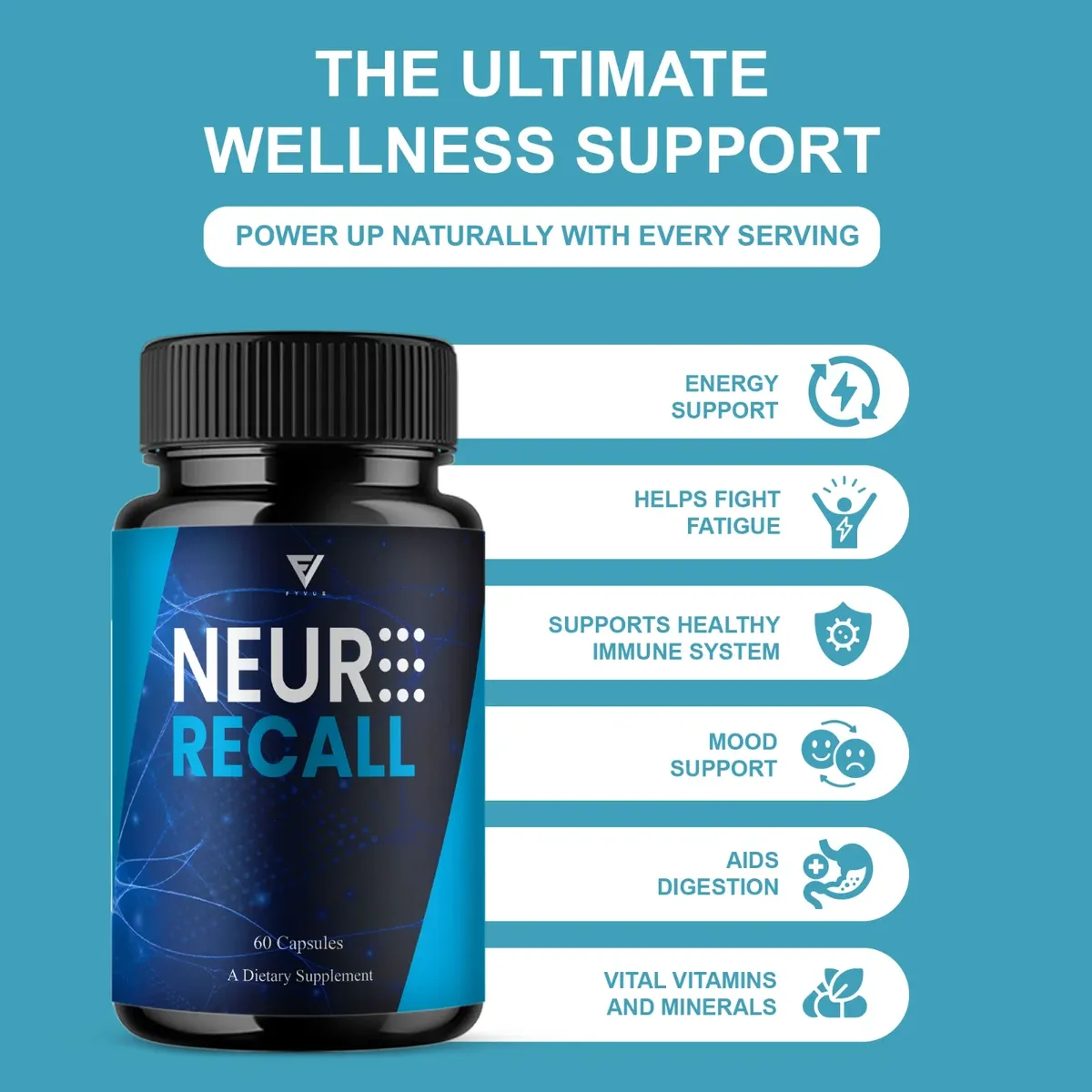
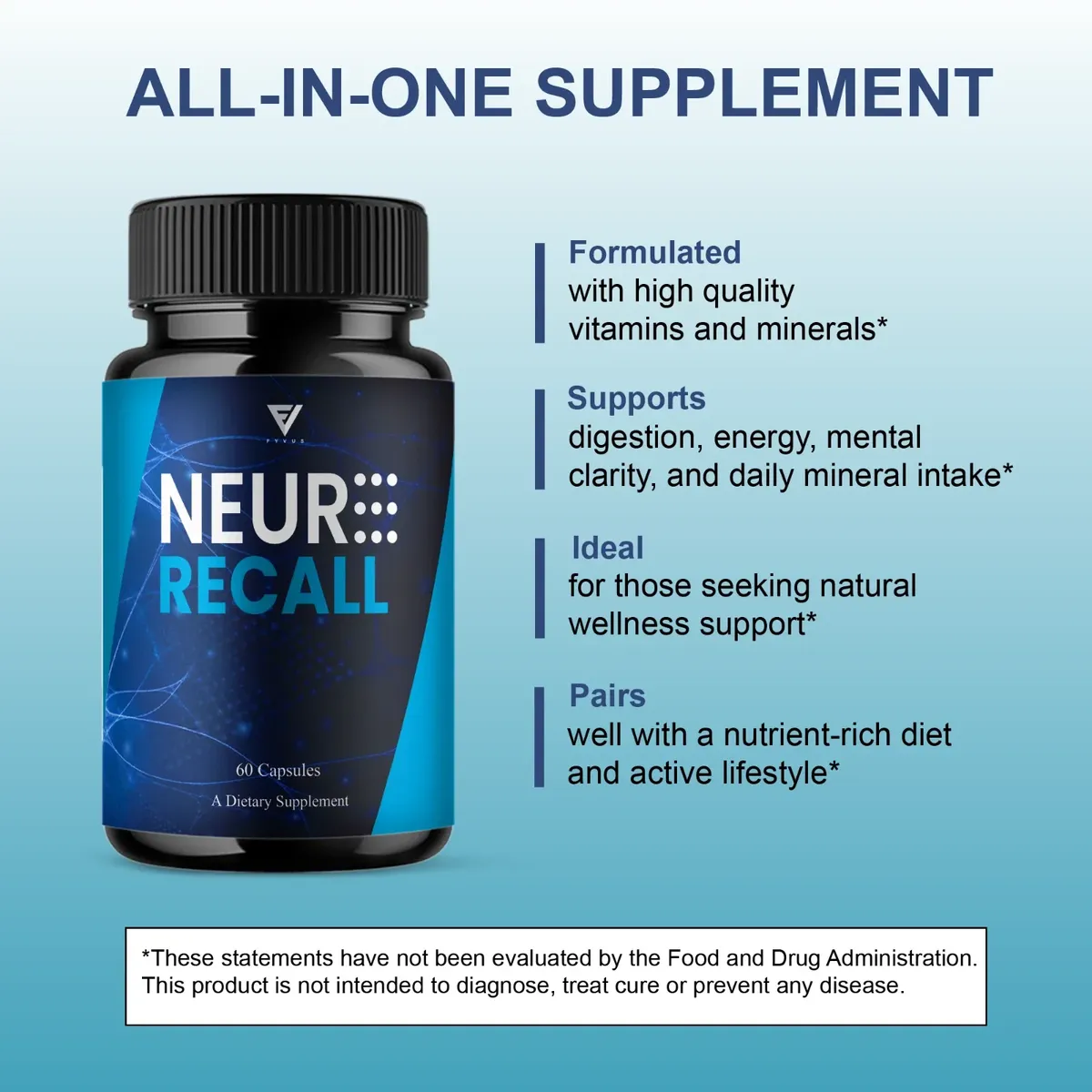
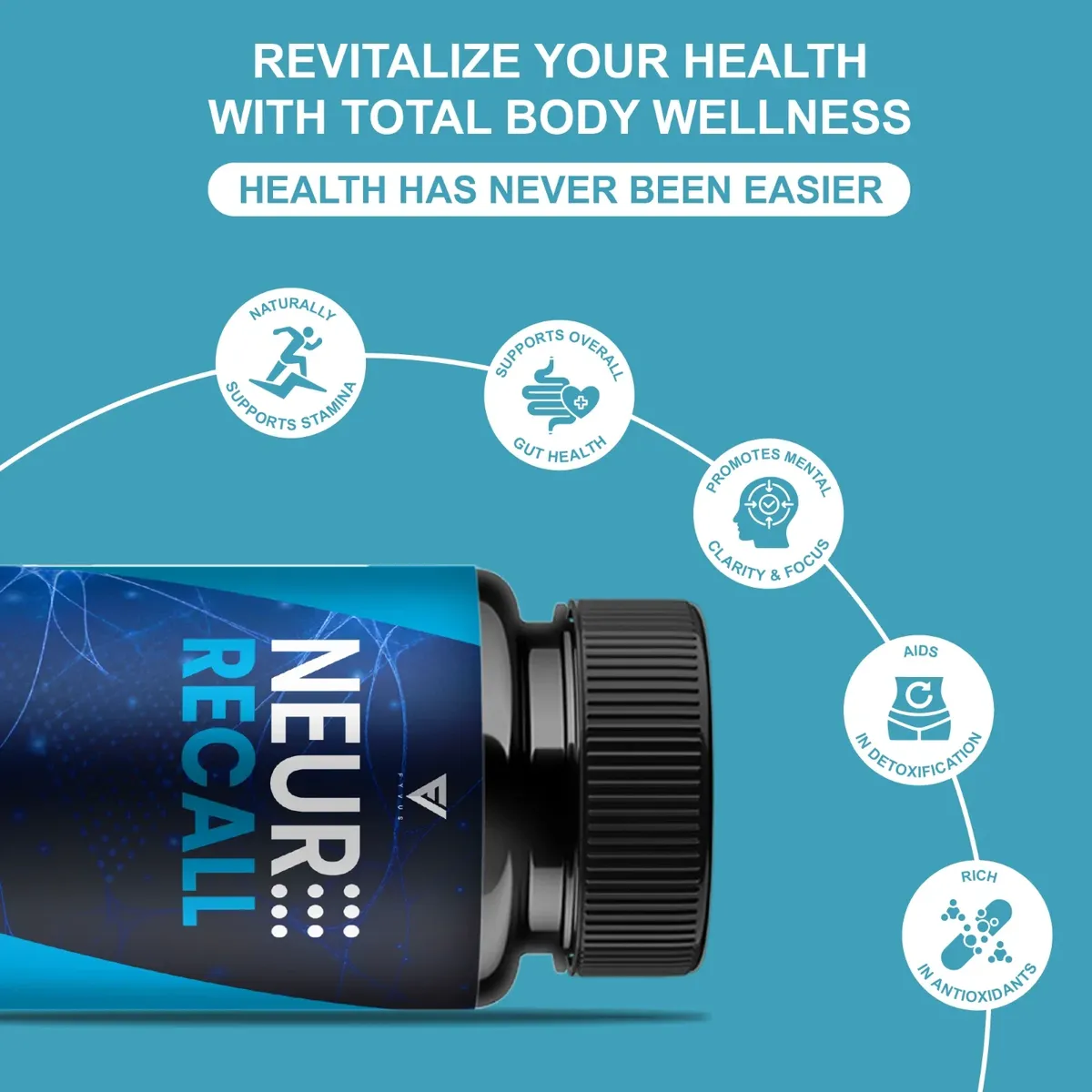
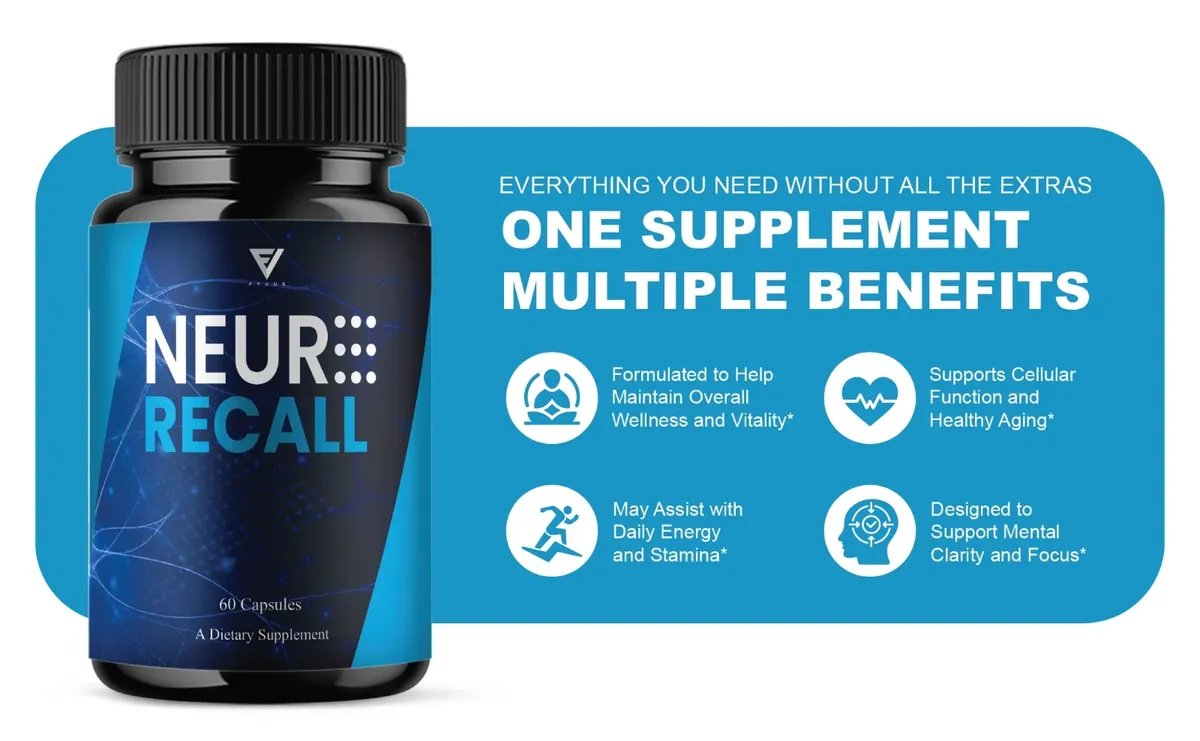
Four more brand graphics from the pack, shown as received. Their words are the brand's, not label claims.
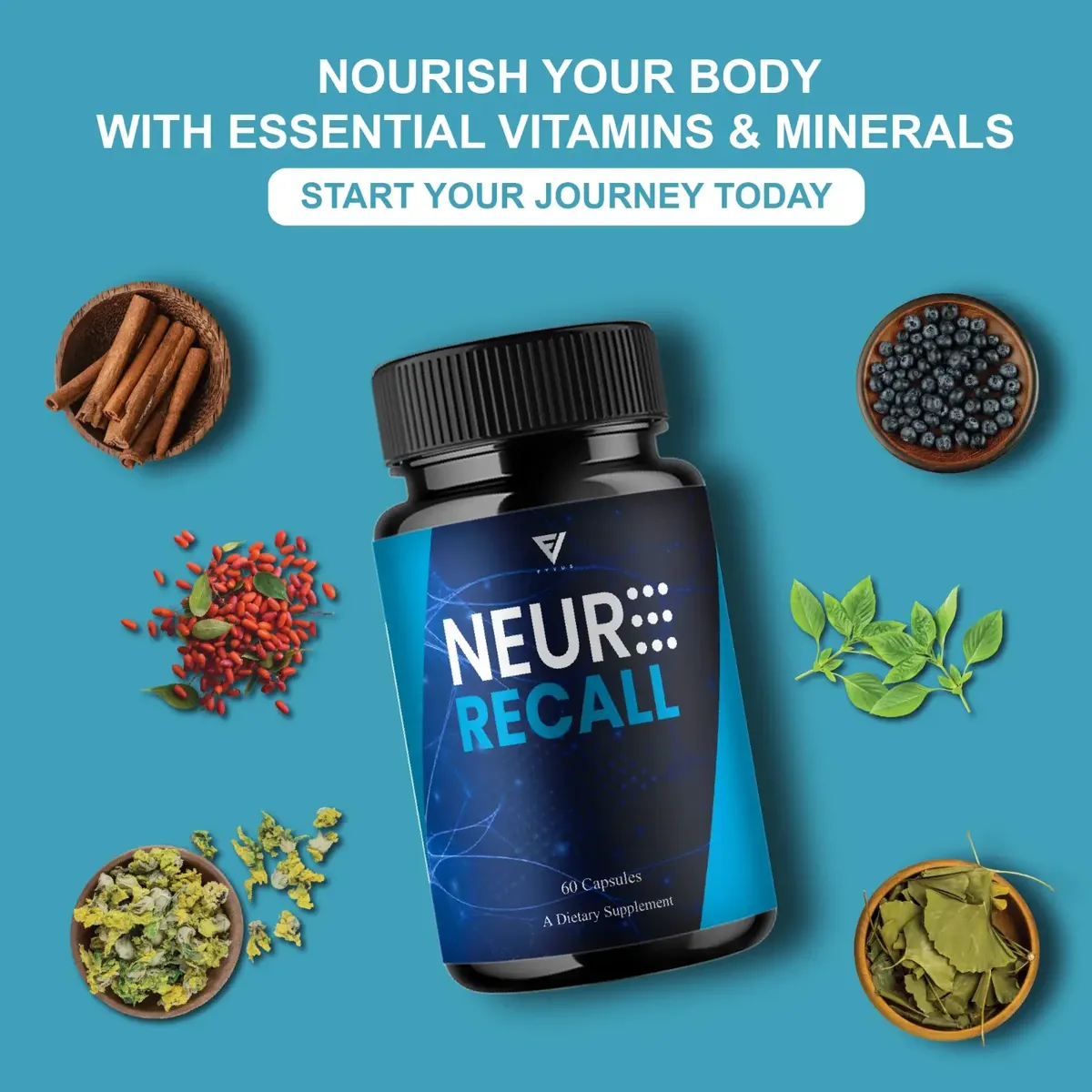
The brand's marketing graphics list phrases such as energy, digestion, mood, immune support, focus and “detox.” They show the bottle next to friendly icons.
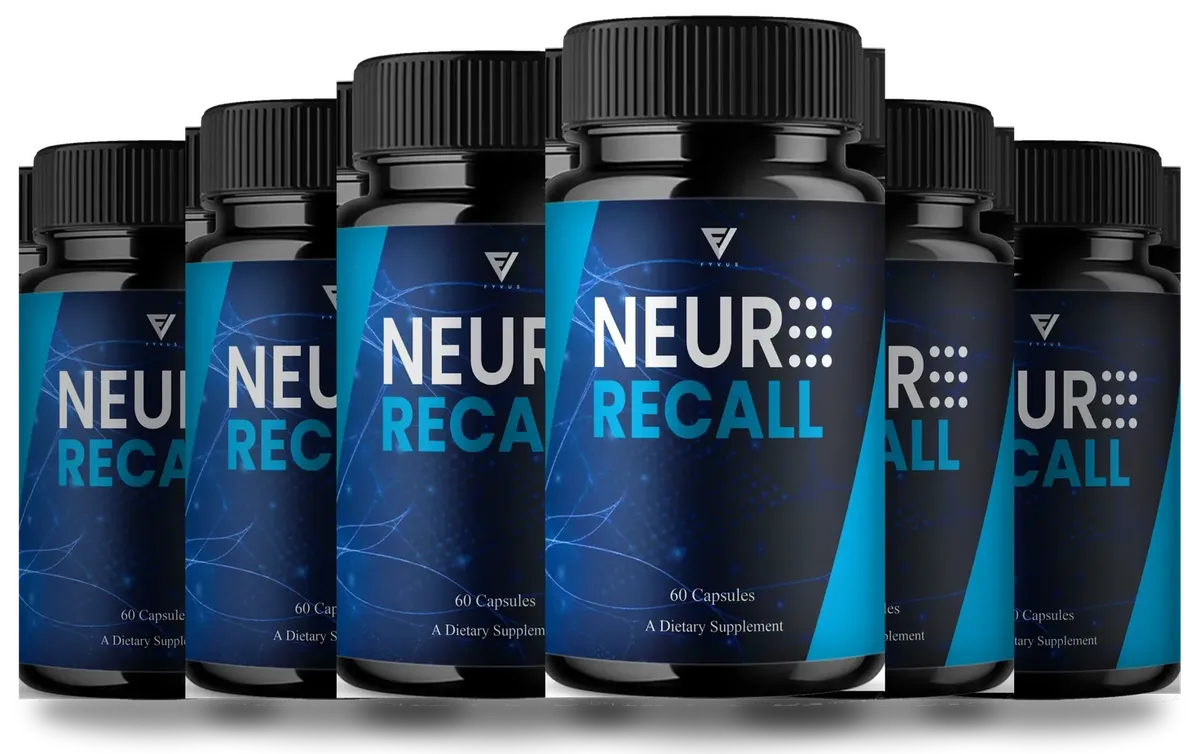
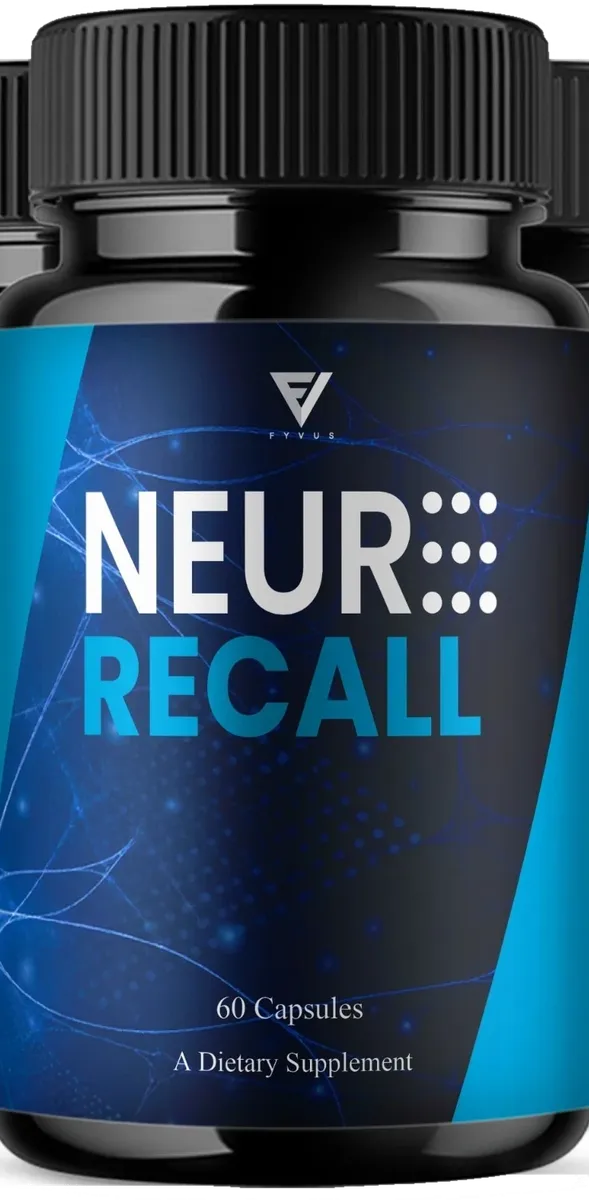
The front label in the brand images says much less. It shows the name, “60 Capsules” and “A Dietary Supplement.” None of the wellness phrases are printed on the bottle.
We could not find a study behind those phrases for Neuro Recall. Read them as advertising. The rest of this page sticks to the label and the research. You can see the full panel on the Supplement Facts page.
What is each ingredient studied for?
Fourteen items, one line each, with the source beside every finding.
| Ingredient (amount per 2 capsules) | What researchers looked at | What they found | Source |
|---|---|---|---|
| Vitamin B12 (240 mcg) | Memory and nerve health in people with low B12 | Fixing a deficiency matters; extra B12 is not shown to help people with normal levels | (NIH ODS, Vitamin B12) |
| Folate (600 mcg DFE) | Healthy blood cells and pregnancy | Needed by everyone; high folic acid can hide a low B12 level | (NIH ODS, Folate) |
| Magnesium (250 mg) | Muscle, nerve and heart function | Most people get some from food; too much from pills causes diarrhea | (NIH ODS, Magnesium) |
| Chromium (120 mcg) | Blood sugar control | May lower blood sugar with diabetes medicines | (NIH ODS, Chromium) |
| Ginkgo biloba | Memory, dementia prevention | No drop in dementia or decline over about 6 years | (Snitz et al., JAMA 2009) |
| Bacopa monnieri | Attention and learning | Small gains in attention speed after 12+ weeks; memory unclear | (Kongkeaw et al., 2014) |
| L-theanine | Calm, sleep, focus | Limited human data from small studies | (MSKCC, L-theanine) |
| Alpha lipoic acid | Blood sugar, nerve pain | Can lower blood sugar; not a memory ingredient | (MSKCC, Alpha-lipoic acid) |
| Alpha-GPC | Thinking in older adults | Benefit for healthy adults is unclear | (WebMD, Alpha-GPC) |
| Lutein and zeaxanthin | Eye health | Used in an eye study at 10 mg and 2 mg; not a memory study | (NEI, AREDS and AREDS2) |
| Green tea extract | Weight, heart, alertness | No memory dose set; rare liver injury from pills | (NCCIH, Green tea) |
| Berberine | Blood sugar and cholesterol | Studied for metabolism, not memory | (MSKCC, Berberine) |
| Cinnamon | Blood sugar | Research does not clearly support it for any condition | (NCCIH, Cinnamon) |
| Bilberry | Eyesight, circulation | Not clearly shown to help any condition | (NCCIH, Bilberry) |
Read the table from top to bottom and a pattern shows. Only a few items were ever studied for memory, and those results were weak. Several others were studied for blood sugar, which matters for safety more than for benefit. The ingredients page has the full label order and amount limits.
Vitamin B12 and folate: the clearest use on the label
B12 is the one item with a direct link to memory. When B12 runs short, the NIH lists confusion and trouble remembering among the effects (NIH ODS, Vitamin B12). Your doctor can tell you whether your age, diet or medicines make a low level more likely.
Each 2-capsule serving of Neuro Recall carries 240 mcg of B12. That is 100 times the 2.4 mcg adults need each day. If you are low, that helps. If your level is already normal, the extra is not shown to help memory.
Folate comes as 320 mcg of folic acid, under the 1,000 mcg upper limit (NIH ODS, Folate). One catch matters here. High doses of folic acid can hide a B12 shortage. That is one more reason to test first.
Practical step
A blood test can show whether B12 is part of the picture. Ask for it before buying any memory product. Our article on the B12 test to ask for first explains what to say at the appointment.
Is there proof that pills for memory pay off?
For most healthy adults, the honest answer is “not much, based on current research.” The two largest bodies of evidence below show why. NCCIH also keeps a plain overview of supplements sold for memory, dementia and Alzheimer's (NCCIH, Supplements for cognitive function).
Ginkgo is the clearest case. In the GEM trial, 3,069 adults aged 72 to 96 took 120 mg twice a day or a dummy pill. After a median of 6.1 years, cognitive decline did not differ between the groups (Snitz et al., JAMA 2009).
Bacopa looks a little better. A review of nine trials found small gains in attention speed after 12 weeks or more at about 300 mg a day (Kongkeaw et al., 2014). Memory itself showed no clear change, and the reviewers called for bigger studies.
- 3,069adults in the GEM ginkgo trial
- 6.1 yrsmedian follow-up with no difference
- 9bacopa trials pooled in one review
- 0published trials of Neuro Recall
Honest note: where the evidence runs thin
Ten herbs and nutrients share one 635 mg blend, so most of them can only be present in small amounts. The chart below compares the most the label order allows with the doses used in research.
Bacopa monnieriAbout half at most
Ginkgo bilobaDose not the problem
In the largest ginkgo trial, 240 mg a day for about six years did not lower dementia rates, so a bigger dose is not the missing piece. (Snitz et al., JAMA 2009)
Vitamin B12100x the RDA
240 mcg equals one hundred times the daily need of 2.4 mcg. It fixes a shortfall; it has not been shown to sharpen memory beyond that. (NIH ODS, Vitamin B12)
Whole blend635 mg for 10 items
Ten herbs and nutrients split 635 mg, so most of them can only be present in small amounts. (21 CFR 101.36)
A lower dose does not prove an ingredient fails. It does mean the studied dose was not what you are taking. See how long the studies ran before you decide how long to try it.
Pros and cons of Neuro Recall at a glance
What works in its favor
- A simple routine: 2 capsules once a day, 30 days per bottle.
- The vitamin and mineral amounts are printed exactly on the label.
- If a lab result shows low B12 or folate, the label covers both.
- The full ingredient list is printed, so a pharmacist can check it.
- One capsule routine replaces several separate bottles for people who already planned to take these items.
What to weigh first
- No published trial of Neuro Recall itself.
- Ginkgo, the best-known memory herb, failed in the largest trial.
- Bacopa is at most about half the dose used in studies.
- Herb amounts inside the 635 mg blend are not printed.
- Several ingredients can lower blood sugar or add to bleeding risk.
- Wellness phrases on the brand graphics were not verified.
Everyday habits that beat a capsule on evidence
The steps with better support are not sold in a bottle. Doctors point to sleep, activity, blood pressure and blood sugar control, hearing care, social contact and treating a B12 shortage.
None of these needs a prescription. Most can start this week, and many families find it easier to do them together.
Sleep
Aim for steady sleep at regular times. Ask about snoring or pauses in breathing, which a doctor can test for.
Move most days
Walking, swimming or chair exercise all count. Pick something you will still be doing in three months.
Blood pressure
Blood pressure control is one of the habits doctors link to brain health. Know your numbers and take prescribed medicine as directed.
Blood sugar
Keeping diabetes in the range your care team sets is part of the same brain-health list.
Hearing and vision
Untreated hearing loss makes conversation tiring. A hearing test and up-to-date glasses are simple steps.
People and purpose
Regular contact with friends, groups or volunteering keeps the mind engaged. Loneliness is worth taking seriously.
Our guide to brain-health habits after 50 turns each one into small weekly steps.
A benefit check sheet for families
If you or a parent decides to try it, set it up so you can judge it fairly. Six notes made before the first capsule make the later decision much easier.
Before day one, write down
- Write down why you want to try it. “Fewer missed names” is easier to track than “a sharper mind.”
- Ask for a B12 blood test first. If it is low, your doctor will treat that directly.
- List every medicine and supplement, including aspirin, diabetes pills and thyroid medicine.
- Count other sources of folic acid, B12 and magnesium, such as a multivitamin.
- Pick a review date about 12 weeks out and put it on the calendar.
- Agree on what would make you stop: stomach trouble, bruising, shaky spells or no change at all.
Not sure it is a fit at all? Start with who should and should not take it.
What people ask about Neuro Recall benefits
What can Neuro Recall realistically do for someone?
No benefit has been proven for Neuro Recall itself, because no trial of the product is published. Its B12 and folate help people who are low in them, and its herbs have been studied for things like attention speed, blood sugar and eye health.
Is there good proof that memory pills help healthy adults?
Not much. The biggest ginkgo trial found no drop in dementia or decline, and pooled bacopa trials found only small attention gains. NCCIH keeps a plain-language overview of this research.
Does Neuro Recall help with memory?
There is no direct evidence that it does. The closest research is on single ingredients at different doses, and those results were small or negative.
Is ginkgo biloba good for memory?
The largest trial says no. About 3,000 older adults took 120 mg twice a day for around 6 years, and their rates of dementia and cognitive decline matched the placebo group.
Why is bacopa in a memory formula at all?
Bacopa has been studied for thinking speed. Trials of about 300 mg a day for 12 weeks or more found small gains in attention speed but no clear memory benefit.
Will extra vitamin B12 sharpen recall?
It helps if you are low. A B12 deficiency can cause confusion and memory problems, but extra B12 has not been shown to help people who already get enough.
Will Neuro Recall boost energy, mood or digestion like the graphics say?
Those phrases live on the brand's promo artwork; the bottle label never prints them. They were not checked by the FDA or by us, and no study of Neuro Recall tests them.
Does Neuro Recall detox your body?
No study shows that. “Detox” is a marketing word on a brand graphic. Your liver and kidneys already clear waste, and no capsule has been shown to do that job for them.
Is Neuro Recall clinically proven?
No. No clinical trial of Neuro Recall has been published, and the FDA does not approve supplements before they are sold.
Could taking Neuro Recall lower my chance of getting Alzheimer's?
No supplement has been shown to prevent dementia or Alzheimer's disease. Ginkgo, the best-known memory herb, failed to do so in a 6-year trial.
Ready to try Neuro Recall?
Two capsules once a day, a full printed label, and the price shown on the checkout before you pay. Buying for a parent? Show the label to their doctor or pharmacist first.