Does NeuroRecall Really Work for Memory? What the Studies Can Show
Quick answerDoes Neuro Recall really work? Nobody can say for sure, because no trial of the Neuro Recall capsule has been published. Studies on its single ingredients are mixed. Ginkgo did not lower dementia rates in a large trial, and bacopa showed small gains in attention speed at about twice the dose this capsule can hold. B12 matters only when your level is low.
What should you know first about whether it works?
Key facts
- No published trial of the Neuro Recall capsule exists, so no memory benefit has been shown for the product itself.
- In the GEM trial, 3,069 adults aged 72 to 96 took ginkgo 120 mg twice daily or a dummy pill. After a median of 6.1 years the two groups did not differ.
- Pooling nine bacopa trials, a review saw slightly quicker attention after at least 12 weeks on about 300 mg a day.
- Neuro Recall can hold at most about 158.8 mg of bacopa per serving, so about half the studied dose at best.
- Each serving has B12 at 240 mcg. Adults need 2.4 mcg a day, and extra B12 helps only people who run low.
- Poor sleep, low mood, hearing loss, medicines, thyroid problems and low B12 can each affect memory. A doctor can check them.
What would it mean for Neuro Recall to really work?
Your neighbor says it helped. An ad says it will. The bottle itself says nothing about results. So who is right? Only a fair test can settle it.
A fair test gives one group the product and another group a dummy pill. Neither group knows which it got. Then researchers measure memory the same way in both. That is how a trial separates a real effect from hope, a good week and a changed routine.
Nobody has run that test on Neuro Recall. Every claim you read about the capsule as a whole is therefore a guess, including the hopeful ones.
What did the large ginkgo trial find?
Ginkgo is the second item in the blend, and it is the best-known memory herb on the label. The GEM trial gave it a hard test. Its 3,069 volunteers, aged 72 to 96, were given either ginkgo at 120 mg twice daily or a dummy pill. (Snitz et al., JAMA 2009)
After a median of 6.1 years, dementia rates and memory decline did not differ between the groups. A bigger dose would not have fixed that, because the trial used a full dose. A serving could hold as much as 317.5 mg of ginkgo, so a low dose cannot explain the result.
Ginkgo also carries a bleeding warning for people on blood thinners. (NCCIH, Ginkgo) That is a safety cost without a proven memory gain.
How do the capsule's doses compare with the study doses?
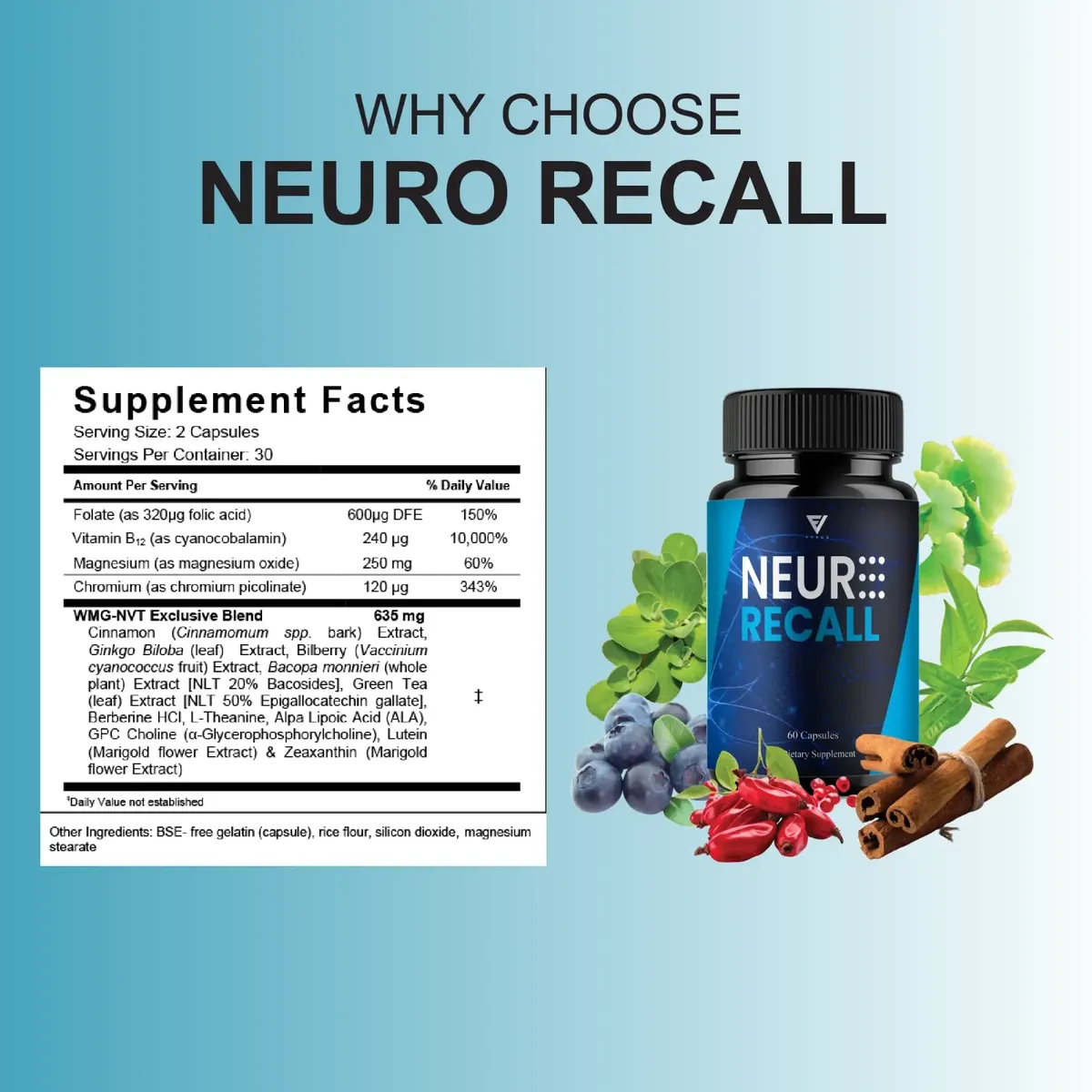
The table below sets the most each herb can weigh in a serving beside the dose that was studied. The herb amounts are ceilings from label order, not printed figures.
| Ingredient | Most one serving can hold | Dose in studies | What it means |
|---|---|---|---|
| Ginkgo biloba leaf extract | Up to 317.5 mg | 240 mg a day (120 mg twice daily) in the GEM trial | The dose could match, yet no dementia benefit was found |
| Bacopa monnieri extract | Up to 158.8 mg | About 300 mg a day for 12 weeks or more | About half at most |
| Lutein and zeaxanthin | Up to 63.5 mg combined | 10 mg plus 2 mg a day in an eye study | An eye study, not a memory study |
| Vitamin B12 | 240 mcg | Dose set by a doctor for a shortfall | Helps if you are low; extra is not shown to help |
| Berberine and alpha lipoic acid | Up to 105.8 mg and 79.4 mg | Studied mainly for blood sugar and nerves | Not memory ingredients |
Does bacopa do more than ginkgo?
A little. One review pooled nine bacopa trials. It saw slightly faster attention after 12 weeks or longer on roughly 300 mg a day. (Kongkeaw et al., 2014) Memory itself did not clearly improve, and the reviewers asked for bigger studies.
Neuro Recall lists bacopa fourth. By label order, a serving holds at most about 158.8 mg. That is about half of what the studies gave people, and the true figure may be smaller. So even the small effect may not carry over.
Can B12 and folate help your memory?
Only if you are short on them. A B12 shortfall can cause muddled thinking and memory slips. (NIH ODS, Vitamin B12) In that case, treating the shortfall matters. Each serving has 240 mcg, which is one hundred times what adults need in a day.
If your level is already normal, there is no sign the extra helps. Folate is printed as 600 mcg DFE, made from 320 mcg of folic acid. High folic acid can hide a low B12 level (NIH ODS, Folate), so a blood test first is the smarter step.
Why might someone feel better on Neuro Recall anyway?
Many things move memory: sleep, stress, mood, hearing, medicines, thyroid problems and low B12. Starting any new routine makes people watch their own memory more closely. That can feel like a gain. This is the reason trials use a dummy pill as the comparison.
A feeling is still a real feeling. It just cannot tell you the capsule caused it. If you notice a change, write it down with a date. Do not stop a medicine or skip a doctor visit because of it.
How can you test Neuro Recall fairly at home?
Write a baseline
Before day one, note your sleep, your mood and three real moments of forgetting.
Change one thing
Do not start a new sleep plan or a new supplement in the same weeks.
Stick to the label
Take 2 capsules a day, unless your health care provider says otherwise.
Ask someone who sees you often
A spouse or grown child may spot changes you miss.
Set a review date
About 12 weeks matches the bacopa studies. Put it on the calendar now.
Not FDA approved
Neuro Recall is a dietary supplement. It is not FDA approved, and no supplement is. The bottle says: "*These statements have not been evaluated by the Food and Drug Administration. This product is not intended to diagnose, treat, cure, or prevent any disease."
Frequently asked questions
Does Neuro Recall really work for memory?
Nobody can say yet, because the capsule has never been through a published trial. The studies on its single ingredients were small, mixed or negative for memory. Treat any promise of results as a guess.
Does Neuro Recall work like the ads say?
The ads we know of were reported as fake celebrity videos. The label makes no memory promise. It prints no claim about recall, focus or results.
Is there a clinical trial of Neuro Recall?
None is published. The research on ginkgo, bacopa, B12 and the others covers each ingredient alone, often at different doses from the ones in this capsule.
Would I notice anything in the first week?
You are more likely to notice a side effect than a benefit. The two to watch for are loose stools, from the magnesium oxide, and shaky spells from low blood sugar.
Does a higher dose of ginkgo work better?
Not in the largest trial. It used 120 mg twice daily for a median of 6.1 years and found no difference in dementia rates or memory decline.
Should I try Neuro Recall or see a doctor first?
See a doctor first if memory is slipping, or if you take blood thinners, diabetes medicine or other prescriptions. A B12 blood test is a low-cost first step that may explain a lot.
Has Neuro Recall been tested in its own trial?
No trial of the Neuro Recall capsule has been published. Only single ingredients, such as ginkgo and bacopa, have been studied, and those results are mixed. Take any ad claim about the finished product with care.
What do studies say about the ingredients in Neuro Recall?
Results are mixed. Ginkgo did not lower dementia rates in a large trial, and pooled bacopa trials showed only small attention gains. These studies used single ingredients, not the Neuro Recall blend itself.
Our view
Our view is that Neuro Recall has not earned the word "works". The honest summary is this: a tidy label, a useful dose of B12 for people who are low, and herbs whose best studies are weak or aimed at other goals.
If you still want to try it, treat it as a small, time-limited experiment. Keep notes, set a review date, and let a doctor look at your medicine list first. Better sleep, daily walking and a hearing test have stronger backing than any capsule.